
What to Paint a Concrete Floor With?
To paint a concrete floor, use concrete-specific paints such as epoxy, acrylic latex, or concrete floor paint. Epoxy paint provides a durable, chemical-resistant, and long-lasting finish, ideal for garages, basements, and industrial spaces. Acrylic latex paint is easier to apply and works well for interior floors with light traffic. Before painting, clean and etch the floor, repair cracks, and apply a primer if recommended to ensure proper adhesion and a smooth, long-lasting finish.
If you want a floor that resists hot tires, stains, and chips, you need more than “regular paint.” In this guide on what to paint a concrete floor with, I’ll share proven products, prep steps, and pro tips from years of coating garages, basements, and shops. You’ll learn how to choose the right system for your space and your budget—and get a finish that lasts.
“Once you’ve finished etching the surface it’s time to choose your coating. We’ve ranked the [Top 4 Best Paints for Concrete Floors] here.”
How to choose what to paint a concrete floor with
The best coating depends on your space, use, and budget. When people ask what to paint a concrete floor with, I ask four quick questions first.
- Where is the floor? Garage, basement, patio, shop, or laundry?
- What’s the traffic and abuse? Cars, forklifts, pets, moisture, or UV?
- What is the concrete condition? Moisture, cracks, dusting, old coatings?
- What look do you want? High-gloss, satin, solid color, or stained?
General rule: pick the toughest system you can afford. For hot-tire resistance and chemicals, a 2-part epoxy with a urethane topcoat is hard to beat. For fast return-to-service and extreme durability, polyurea systems shine.
If you want low cost and an easy DIY, water-based acrylic concrete paint can work indoors. But it will not match epoxy or polyurea for wear or hot-tire pickup. This is the key trade-off in what to paint a concrete floor with.
Scientific testing confirms that Epoxy and Polyurethane coatings are significantly more effective than standard paints at creating a dense barrier that reduces chloride ion penetration by over 50%. The study highlights that while epoxy offers superior hardness, polyurethane provides necessary flexibility for areas with temperature fluctuations.
The best options for what to paint a concrete floor with
You have five main categories. Below I explain when to use each and what to avoid. This section gives straight answers on what to paint a concrete floor with for long-term results.
2-part epoxy floor coating
Use for garages, workshops, and heavy-use interiors. It bonds well, builds film thickness, and resists oil, salt, and cleaners.
- Pros: Great adhesion, high build, solid chemical resistance, hot-tire proof when cured.
- Cons: Slower cure, needs careful mixing, can amber in UV without a topcoat.
- Pro tip: Add a urethane or polyaspartic topcoat for better UV stability and abrasion resistance.
Polyurea or polyaspartic coating
Use when you want a one-day system with top-tier durability.
- Pros: Very fast cure, excellent abrasion and chemical resistance, UV stable.
- Cons: Short working time, often pricier, tricky for first-timers.
- Pro tip: Work in small sections and keep a wet edge. Ideal for pro installs or experienced DIYers.
Aliphatic urethane topcoat
Use as a topcoat over epoxy. It locks in color chips, adds gloss, and resists scratches.
- Pros: High UV stability, scuff resistance, easy to clean.
- Cons: Thin mil build; not a standalone base coat for bare concrete.
- Pro tip: Choose low-VOC formulas for indoor work and proper ventilation.
Acrylic concrete paint (water-based)
Use for low-traffic interiors like basements and laundry rooms.
- Pros: Easy to apply, low odor, budget friendly, many colors.
- Cons: Lower durability, prone to hot-tire pickup in garages.
- Pro tip: If you choose this, use a concrete bonding primer first.
Concrete stain plus sealer
Use when you want a natural, variegated look, not a solid color.
- Pros: Adds depth, hides dusting, easier refresh.
- Cons: Less film build, needs more frequent resealing, not for heavy chemical use.
- Pro tip: For porches and patios, pick UV-stable sealers with anti-slip additive.
In short, the most reliable answer to what to paint a concrete floor with for high abuse is an epoxy base with a urethane or polyurea topcoat. For fast-turn projects, a full polyurea system is excellent.
Prep matters more than paint
Good prep is 70% of the job. Even the best coating will fail on a dirty or sealed slab. If you want a dependable result for what to paint a concrete floor with, start here.
- Test for moisture: Tape a 2 ft x 2 ft plastic sheet to the slab for 24 hours. If condensation forms, fix moisture issues or use vapor-tolerant systems.
- Check porosity: Sprinkle water. It should darken and absorb within a minute. If it beads, you need etching or grinding.
- Remove old coatings: Shot-blast or grind to a clean, open surface profile (CSP 2–3 is common for epoxy).
- Degrease: Use a concrete degreaser. Rinse well. Let dry fully.
- Repair cracks: Use epoxy crack filler or a fast-setting polyurea crack repair.
Quick personal tip: My early failures came from skipping a second rinse after etching. Residue kills adhesion. Rinse until runoff is clear.
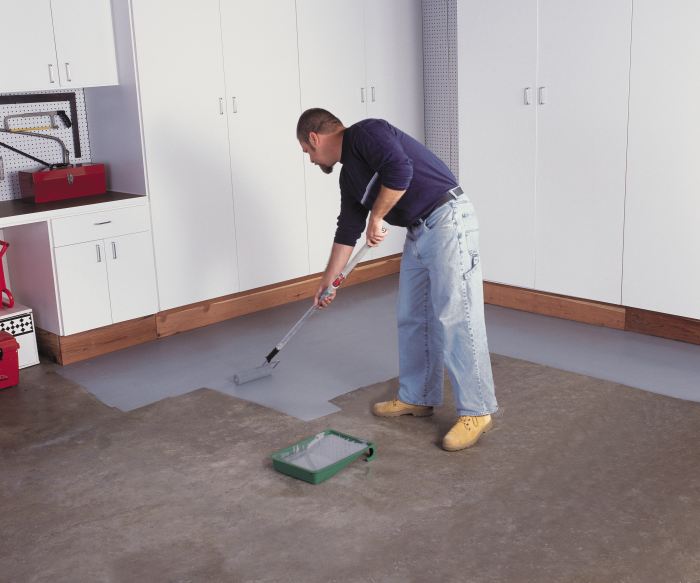
Step-by-step: applying concrete floor coatings
This is the simple, repeatable process I use on most jobs. It fits almost any plan for what to paint a concrete floor with.
- Plan and stage
- Read the datasheets. Note pot life, cure time, recoat window, and temperature limits.
- Gather tools: notched squeegee, 3/8-inch rollers, mixing paddle, spiked shoes, and tape.
- Prime the slab
- Use the manufacturer’s primer, or thin first coat of epoxy, to penetrate and lock down dust.
- Cut in edges, then roll north-south and east-west for even build.
- Build the body coat
- Mix accurately. Time starts the moment Part A meets Part B.
- Pour in ribbons, squeegee out, then back-roll. Broadcast color flakes if desired.
- Topcoat
- After the recoat window, apply aliphatic urethane or polyaspartic. This boosts UV and scratch resistance.
- Add a traction additive for wet areas or ramps.
- Cure and return to use
- Light foot traffic: often 12–24 hours.
- Vehicles: typically 3–7 days depending on product and temperature.
If you are still unsure what to paint a concrete floor with, start with a small test area and track adhesion after a week.
Safety, VOCs, and indoor air quality
Coatings vary in odor, solvents, and VOCs. Plan for ventilation and PPE. This part matters as much as deciding what to paint a concrete floor with.
- Wear gloves, safety glasses, and a respirator rated for organic vapors when needed.
- Ventilate with fans. Create crossflow. Avoid open flames and pilot lights.
- Check VOC rules in your state. There are low- and zero-VOC options that still perform well.
Industry standards and testing back up performance claims, like abrasion resistance and hot-tire tests. But real-world prep and conditions often matter more than lab numbers.
Design ideas, traction, and finish options
You do not have to choose plain gray. Even when thinking through what to paint a concrete floor with, style and safety should guide your finish.
- Color flakes: Great at hiding dirt and adding grip. Use medium broadcast and lock with a clear topcoat.
- Metallic epoxy: Bold look for showrooms or home gyms. Use in dry interiors only.
- Anti-slip: Add silica or polymer beads to topcoats in wet zones.
- Sheen: Gloss looks sharp but shows dust. Satin hides more and still cleans well.
Personal note: In mudrooms, I always add extra traction. It beats slipping on a rainy day.
Maintenance and touch-ups
A good coating is easy to live with. Your plan for what to paint a concrete floor with should include simple care.
- Sweep or vacuum grit weekly. Grit acts like sandpaper.
- Mop with a neutral pH cleaner. Avoid harsh degreasers daily.
- Use soft tires or mats at hot tire zones if you went with budget paint.
- For chips: Sand the area, wipe clean, spot-coat, and feather edges. Re-topcoat if needed.
If you apply a urethane topcoat, you can refresh sheen later without stripping the whole floor.
Costs, coverage, and timelines
Budget helps narrow what to paint a concrete floor with. Costs vary by mil thickness, chemistry, and brand.
- Acrylic paint: Low cost, thin build, quickest to apply, shorter life.
- Epoxy plus urethane: Mid to high cost, best value for garages and shops.
- Polyurea systems: Higher cost, fastest cure, top durability.
Coverage ranges from about 150 to 250 square feet per gallon per coat, depending on viscosity and profile. Most two-car garages need a primer, a body coat, flakes, and a topcoat. Plan a weekend for install and a few days for cure before parking.
Frequently Asked Questions of what to paint a concrete floor with
What is the most durable option for a garage?
A 2-part epoxy base with an aliphatic urethane or polyaspartic topcoat is a proven system. It resists hot tires, road salts, and oil.
Can I use regular wall paint on concrete floors?
No. Wall paint lacks adhesion and abrasion resistance. It will scuff, peel, and fail fast, especially under tires.
How do I know if my slab needs etching or grinding?
Do a water drop test. If water beads, you need etching or grinding to open pores and improve adhesion.
Will epoxy yellow in sunlight?
Most epoxies amber with UV. Use an aliphatic urethane or polyaspartic topcoat for UV stability on sunlit areas.
How long before I can park on a new coating?
Light foot traffic is often 12–24 hours. Vehicles usually need 3–7 days, depending on product and temperature.
Conclusion
You have many choices, but the right answer starts with your space and use. For most garages and shops, a 2-part epoxy with a urethane or polyurea topcoat gives the best blend of cost, looks, and life. For fast-turn projects, polyurea shines. For light-duty interiors, acrylic concrete paint can still work.
Pick your system, prep with care, and follow the datasheet like a recipe. You will get a floor that looks sharp and stands up to real life. Ready to start? Save this guide, explore more how-tos, and drop your questions or project plans in the comments.
Related posts:
 Best Paint for Concrete Floor (2025) – Top Picks for Garages & Basements
 Best Paint for Propane Tank – Weather-Resistant Coatings That Won’t Trap Heat | Safety Expert Guide
 How to Match a Behr Paint Color to Benjamin Moore (2026) – Accurate Methods Paint Stores Don’t Tell You
 Best Marine Paint for Metal (2026) – Long-Lasting Protection Against Saltwater & Corrosion | Expert Tested