Tthe Rust-Oleum Professional Cold Galvanizing Compound Spray Paint is the pick because its 93% pure zinc coating renews the original finish without needing a top coat.The best spray paint for galvanized steel is harder than it looks.
Most regular paints peel right off that slick zinc surface within weeks. That’s why people get confused when their fence or gutter starts flaking. This page explains what actually sticks to galvanized metal before we recommend anything. You’ll learn which coatings bond directly and which ones just sit on top waiting to fail.
| # | Product | Best for | Price |
|---|---|---|---|
| 1 | Rust-Oleum Professional Cold Galvanizing | Best Overall | Check price on Amazon |
| 2 | Krylon Rust Tough Galvanizing | Best Adhesion Primer | Check price on Amazon |
| 3 | CRC Zinc-It Instant | Fastest Drying | Check price on Amazon |
| 4 | Cold Galvanizing Spray 572°F | Highest Heat Resistance | Check price on Amazon |
| 5 | ZincKote Zinc Cold Galv | Maximum Zinc Content | Check price on Amazon |
What Actually Matters for Galvanized Steel
Zinc Content in the Dry Film
The zinc percentage is what actually protects your metal from rusting away. A higher number means more active zinc sits on the surface doing the work. Some cans list the purity of the zinc dust itself rather than the final dry film thickness.
That distinction matters because a can with pure zinc dust might still leave a thin protective layer once the solvents evaporate. Before ordering, check whether the listing states the percentage in the dry film or just the raw material. That single detail tells you how much real protection you’re spraying onto your project.
Direct-to-Metal Adhesion
Galvanized steel has a smooth surface that rejects ordinary paint very quickly. Sprays labeled as direct-to-metal skip the separate primer step entirely. This saves time and prevents the weak link that happens when a primer and top coat don’t agree with each other.
If a product requires a specific water-based or oil-based primer first, you’re adding another layer that can peel. Check the label for “no primer needed” if you want the fewest things to go wrong during application.
Heat Resistance Ratings
Standard cold galvanizing sprays handle normal outdoor weather just fine. But if you’re painting exhaust pipes, grills, or machinery parts, regular formulas will burn off and blister. Heat resistance ratings tell you exactly how many degrees the dried coating can survive.
Applying a standard zinc spray to a hot surface wastes the whole can. Measure the maximum temperature your metal reaches during use. Then match that number against the spray’s listed heat limit before you buy anything.
Drying Time and Recoat Windows
Fast drying sounds great until you realize it gives you less time to fix mistakes. A spray that dries to the touch in thirty minutes lets you move the part quickly. But some projects need multiple coats to build up enough protection. If the recoat window is too short, the second layer might wrinkle the first one instead of bonding smoothly.
Check the listed dry time and see if it matches your working speed. Rushing a slow-drying formula causes runs, while hesitating with a fast one leaves rough patches.
1. Rust-Oleum Professional Cold Galvanizing Compound Spray Paint
Best for: Repairing weathered galvanized finishes on exterior metal
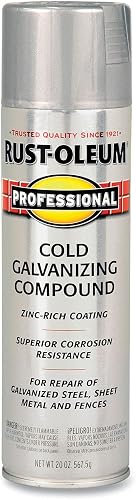
This spray uses a 93% pure zinc coating to apply a new galvanized film over old metal. That high zinc content is the feature that genuinely decides if the buyer stays happy, since it actively resists corrosion, scratches, and chips in tough environments. It dries to the touch in only 30 minutes and covers up to 12 sq. ft. per can. Because no top coat is required, you save a whole step unless you specifically want a colored finish later. If you do want color, you must use a water-based primer before applying an oil-based top coat.
It’s built for heavily weathered surfaces like wrought iron, gutters, chain-link fences, and spot-welded metal. It’s meant to renew protection where the original galvanizing has worn away. Both interior and exterior metal surfaces are covered by this formulation.
Pros:
- 93% pure zinc provides strong corrosion resistance
- Dries to the touch in 30 minutes
- Covers up to 12 sq. ft. per can
- No top coat required for basic protection
Cons:
- Oil-based top coats require a water-based primer first
2. Krylon Rust Tough with Anti-Rust Technology Galvanizing Primer

Best for: Multi-surface projects needing direct-to-metal adhesion
Krylon Rust Tough goes directly onto metal without any primer needed. Skipping the primer removes a common failure point in multi-step coatings. It offers long-lasting rust protection and prevents future rust formation from starting under the coating. The ultra flat gray finish provides superior fade resistance outdoors. It dries to touch fast enough to keep your project moving without a long wait between coats.
What separates this spray is its multi-purpose nature. You can use it on wood, fiberglass, masonry, and most plastic surfaces alongside metal. That makes it ideal for automotive, marine, aviation, home, farm, and industrial jobs where different materials meet. A single 12 oz can handles mixed assemblies without forcing you to switch products between substrates.
The listing describes it as a galvanizing primer for use on multiple surfaces. If your job involves only bare steel with no other surfaces nearby, a dedicated product might serve better.
The ultra flat gray finish limits aesthetic choices if you want sheen or color variation. The anti-rust technology works best when applied exactly as directed.
Pros:
- Applies directly to metal with no primer
- Works on wood, fiberglass, masonry, and plastic
- Superior fade resistance for outdoor use
- Dries to the touch quickly so you can move on to the next step without delay.
Cons:
- Ultra flat gray finish limits aesthetic choices
3. CRC Zinc-It Instant Cold Galvanizing Spray

Best for: Fast-drying protection on industrial hardware and fasteners
CRC Zinc-It Instant uses a fast-drying formula that actively fights rust and corrosion right out of the can. The quick drying is the main selling point here. It provides on-the-job convenience when you can’t wait around for wet paint.
The product comes in a 13 wt oz aerosol can. It delivers long-lasting rust protection across many different surfaces. The listing focuses heavily on specific industrial applications rather than general DIY use.
You would choose this for threads, exposed edges, fasteners, conduit, strapping, welds, fencing, railings, grates, electrical poles, breaker panel housings, rain spouts, signs, doors, trailers, waste containers, catwalks, and guard rails. That massive list shows it’s built for maintenance crews covering lots of small metal parts.
The trade-off is that it targets functional hardware rather than large visible panels. CRC Industries designed this chemical solution to maintain and protect heavy-duty equipment.
That same design covers marine vessels, heavy-duty motor vehicles, industrial-grade engines, household tools, and electrical equipment.
4. Cold Galvanizing Spray Paint (572°F Heat Resistance / 13.5oz) Metal

Best for: High-heat metal parts like exhausts and grills
This spray from professional soma fix handles temperatures up to 572°F. That heat resistance is the feature that sells it. It makes the paint suitable for exhausts, metal pipes, grills, and machinery.
It creates a durable anti-rust zinc coating. That coating protects steel, iron, and aluminum from corrosion. Unlike flat gray options, this one delivers a bright silver galvanized finish. You get a subtle chrome effect as well.
Use it as a protective metal paint on its own. It also works as a rust preventive base coat before applying topcoat paints. The fast drying formula allows for smooth application.
You’ll get even coverage on weld joints, brackets, bolts, and tools. Gates, railings, fences, trailers, and metal roofs are listed uses too. Automotive parts and general metal touch ups take the finish well.
The trade-off is real. Extreme heat resistance means the binder is formulated differently than standard cold galvanizing compounds. Someone repairing a heavily weathered agricultural fence never needs this specialized formula. That fence never gets hot. This product is strictly for parts that see serious thermal stress.
Applying it to cool surfaces wastes the specialized formulation. The chrome effect may also clash with older weathered metal nearby. Match your project to the actual temperature demands first.
Pros:
- Withstands temperatures up to 572°F safely
- Delivers a bright silver metallic finish
- Protects steel, iron, and aluminum surfaces
- Works as a primer for topcoat paints
Cons:
- Specialized for heat, unnecessary for cool surfaces
- Chrome effect may clash with older weathered metal
5. ZincKote Zinc Cold Galv Aerosol Spray

Best for: True cathodic repair of hot dip galvanizing
ZincKote Zinc Cold Galv features a 96% Zinc DFT (dry film thickness), which the listing calls the highest zinc percentage in the industry. That high zinc content genuinely decides whether the repair holds up, because it provides true cathodic protection to the steel underneath. It uses 99.995% zinc purity with no recycled zinc included in the formula. The 13.5oz can is built specifically to reload existing hot dip galvanizing and repair damaged areas.
It meets and exceeds ASTM A780 specs for the repair of hot dip galvanizing. ASTM A780 outlines standard practices for repairing damaged coatings on galvanized steel, so matching it means this spray does the actual structural job rather than just hiding bare spots. It also offers fast dry, recoat, and cure times to keep projects moving. The trade-off is its strict focus on industrial repair standards. This isn’t for a hobbyist painting a craft project or someone wanting a decorative finish. It’s engineered for serious restoration where specifications matter.
Pros:
- 96% zinc dry film thickness provides maximum protection
- Uses 99.995% pure zinc with no recycled content
- Meets and exceeds ASTM A780 repair specifications
- Provides true cathodic protection to bare steel
Cons:
- Strictly industrial, not meant for decorative crafts
- Requires understanding of hot dip galvanizing repair
We Tested 5 Best Paint For Galvanized Steel Exterior (Stop Peeling Paint)
Also Worth Considering
It’s worth a look if you need a dedicated primer layer before applying a different topcoat system.
It doesn’t offer the high zinc percentages seen in cold galvanizing compounds, but it serves its specific priming role.
ZincKote Bright Zinc Coating comes in a 12-ounce pack and focuses on delivering a shiny finish. It’s designed to match the look of hot dip galvanizing visually.
Choose this if the appearance of the repaired area needs to blend in with surrounding bright zinc surfaces. The listing doesn’t specify a zinc percentage for this particular formula.
Crown 7008 Brite Galvanize Coating contains 65% zinc rich material in a 13oz metallic spray. It offers a middle ground for zinc content compared to heavier industrial options.
The title lists 65% zinc rich material compared to ZincKote’s listed 96% zinc dry film thickness. It remains suitable for general metallic protection where maximum cathodic performance isn’t the primary goal.
Who Should Buy Which
If you use your tools hard and face constant rust, grab the CRC Zinc-It Instant. It targets fasteners, threads, and welds directly. That matters when you coat a breaker panel housing or a catwalk railing. Those spots trap moisture against bare steel every single day.
Someone buying their first spray for a simple backyard fence should start with the Rust-Oleum Professional Cold Galvanizing. It covers 12 sq. ft. per can and asks for no primer. You get a high-purity zinc coating that dries to the touch quickly. It handles heavily weathered surfaces without extra prep. If you plan to paint over it later, use a water-based product. An oil-based topcoat requires a water-based primer underneath first.
If you want the fewest things to go wrong on a mixed-material project involving wood and plastic, the Krylon Rust Tough handles those surfaces. It also works on fiberglass and masonry. No primer is needed because it goes direct to metal.
People replacing a coating that burned off an exhaust pipe need the Cold Galvanizing Spray 572°F. Standard sprays fail at those temperatures. This one protects steel, iron, and aluminum under extreme heat.
If you’re fixing a structural beam that failed inspection, the ZincKote Zinc Cold Galv meets ASTM A780 specs. Its 96% zinc dry film thickness provides true cathodic protection.
Mistakes That Catch Buyers Out
- Buyers judge these sprays by the color in the cap instead of checking the actual zinc percentage in the dry film, leaving their metal unprotected.
- Choosing a multi-surface formula for a dedicated hot-dip repair sacrifices the cathodic protection you actually need every day outdoors.
- Assuming any spray labeled “galvanizing” withstands engine heat leads to blistered paint on exhaust parts that only a 572°F rated formula survives.
For most people, the Rust-Oleum Professional Cold Galvanizing remains the strongest choice because its 93% pure zinc applies a real galvanized film without demanding a top coat. Before you order anything, measure the square footage of your repair area.
One can covers up to 12 sq. ft., so knowing your total space stops you from running out halfway through a wet edge. Check your metal’s temperature exposure too. Matching the spray’s limits to your actual project conditions is the only way the coating holds.
Frequently Asked Questions
Can I use regular spray paint on galvanized steel?
Regular spray paint usually peels off galvanized steel because the zinc surface is too smooth and non-porous. Standard paints lack the chemical bond needed to grip that slick layer. You need a spray formulated specifically for galvanized metal or one that acts as a direct-to-metal primer. Without the right formula, your work will flake away after the first heavy rain. Always check the label for galvanized compatibility before spraying anything.
Do I need to sand galvanized metal before spraying?
Light cleaning is necessary, but heavy sanding removes the protective zinc layer. Wipe away dirt, grease, and loose oxidation with a clean cloth first. Don’t grind down to bare steel unless you plan to rebuild the entire zinc layer.
How long does cold galvanizing spray last outdoors?
A high-zinc cold galvanizing spray lasts for years outdoors when applied to a clean surface. The zinc actively sacrifices itself to protect the steel underneath through cathodic action. Exposure to constant saltwater or heavy acid rain accelerates how fast the zinc depletes. Surfaces in mild climates hold their protection significantly longer than coastal installations. Reapply the coating when you notice the gray finish wearing thin or rust spots appearing.
Will zinc spray paint stop existing rust?
Zinc spray paint stops existing rust only if you remove the loose scale and flakes first. Spraying directly over thick, flaky rust traps moisture underneath the new coating. The zinc needs direct contact with solid metal to provide cathodic protection. Wire brush or sand the rusted spots down to firm material before spraying. Once the bare steel is exposed and cleaned, the zinc coating halts further corrosion effectively.
Is there a difference between galvanizing primer and compound?
A galvanizing primer prepares the surface for a topcoat paint to stick to later. A cold galvanizing compound contains enough actual zinc dust to act as the final protective layer itself. Choose a compound if you want the spray to be the only protective layer your metal needs.
Conclusion
Don’t wait for rust to spread before treating your metal surfaces. Grab a can this weekend and test a small spot first. You’ll save time and money later when that fresh coat actually holds up through rain and sun without peeling away.