Usually not, because modern turbines spray standard latex straight from the can. Whether you need to thin paint for a Wagner sprayer depends entirely on your specific tool model and the coating thickness. Check your unit’s front label right now to see if it’s an HVLP or an airless design.
When you need to thin paint for your Wagner
Thinning requirements depend on your machine’s motor power and the liquid’s natural thickness.
| Your situation | Answer | Why |
|---|---|---|
| Wagner FLEXiO series spraying wall latex | No | Powerful turbine atomizes unthinned interior paints |
| Wagner Control Spray or basic HVLP | Yes | Small motors choke on heavy wall coatings |
| Applying thin oil or water wood stain | No | Low viscosity flows easily without added solvent |
| Outdoor heavy latex on basic HVLP | Yes | Exterior acrylic is too thick for small nozzles |
| Wagner airless sprayer using standard primer | No | High piston pressure pushes thick liquids easily |
| Chalk-style paint in any HVLP unit | Yes | Dense mineral particles require water to mist |
Paint thickness and turbine power
Your sprayer’s pump type and the coating’s viscosity decide if you must dilute the liquid. Modern homeowner models divide into two groups: high-volume low-pressure (HVLP) units and high-pressure airless units.
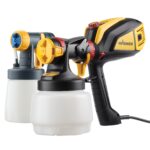
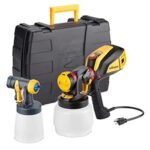
Wagner’s larger consumer units, such as the FLEXiO line, use high-output X-Boost turbines designed to atomize thick residential emulsion directly from the container. In contrast, smaller hobby sprayers use compact motors that lack the air volume to break apart thick liquid strands. When paint is too thick for a motor, the tip spits droplets instead of creating a fine fog.
The coating itself creates the other half of the equation. Water-based latex holds thick polymers, while stains and sealers flow like water. There’s a clear trade-off to consider: thinning latex makes it flow through small sprayers, but it reduces hiding power and can cause runs on flat vertical walls.
This process isn’t for people using professional piston pumps, which push unthinned coatings at over 1,500 pounds per square inch. Always remember that this varies by model — check the label on your sprayer housing for its exact series name.
You can review official setup charts on the Wagner spray guide to confirm your specific motor limits. If your sprayer manual lists a viscosity cup test, thin your paint until it runs through in the specified seconds; if your tool has no testing cup, spray unthinned paint on test cardboard first.
Preparing paint for smooth spraying
Follow these steps to dilute paint safely if your test spray shows heavy spattering.
- Check the paint can label for manufacturer thinning limits before pouring any liquid into your bucket. The Sherwin-Williams application guidelines warn that adding more than 10% water can break down the paint’s binders and ruin washability.
- Pour 1 quart of paint into a separate clean mixing container so you don’t thin your entire paint supply at once. You’ll see a clean working batch ready for testing.
- Add clean room-temperature water at exactly 1 fluid ounce per quart to start with latex coatings. Stir slowly for two minutes until the added water completely disappears into the paint.
- Strain the liquid through a fine mesh paint bag directly into your sprayer cup to catch dried flakes. The liquid should pour smoothly without leaving lumps on the mesh.
- Test the pattern by spraying a scrap piece of cardboard from a distance of 6 to 8 inches. The step worked if the spray leaves an even, wet oval without heavy edges or scattered blobs.
Adding too much water
Over-thinning paint is the single most common mistake, and it ruins the finish completely. People often pour water into the can until the paint runs like milk, hoping to avoid clogs. Doing this breaks the chemical binders that hold the color pigment together.
Once applied, over-thinned paint sags down the wall in runs, leaves poor coverage that requires three or four coats instead of two, and dries to a chalky finish that washes off easily. This mistake wastes hours of work and can cost you an entire extra can of paint.
Check your paint thickness with a simple dip test: lift your stir stick out of the bucket and count the drips. If the stream breaks into individual drops within two seconds, stop adding water immediately.
When to stop and get help
- The motor runs hot and screams with a high pitch, which means the turbine is choking on thick fluid.
- The nozzle continues to clog after three cleanings, which shows the liquid can’t pass through your tip size safely.
- You need to apply high-viscosity elastomeric or roof sealers, which exceed homeowner machine ratings.
Turn to an equipment rental center or hire a professional painter when your project demands commercial-grade coatings that standard household tools can’t push.
Can you use stain in a wagner paint sprayer?
Yes, oil-based and water-based stains work well in these sprayers. Stains have very low viscosity, so you never need to thin them before filling the cup. Use a smaller nozzle setting so the thin liquid doesn’t puddle or drip on your wood.
Why is my Wagner sprayer spitting paint?
Your paint is either too thick for the turbine or the nozzle is partially clogged. Spitting happens when the air stream can’t break the paint stream into fine droplets. Thin latex paint by 5 percent with water or wash the nozzle tip thoroughly.
Does it matter if I thin with tap water?
No, clean tap water works fine for standard interior and exterior water-based latex paints. Never use water for oil-based paints or lacquers, which require mineral spirits. Stir your liquid gently to blend the water without whipping air bubbles into the mixture.
What happens if paint isn’t thinned enough?
The sprayer will lay down an uneven texture resembling an orange peel across your surface. The motor will run hot because the internal air pressure struggles to push the fluid. Your spray pattern will show thick blotches at the edges rather than an even mist.
How do I know if my paint needs thinning?
Test spray a scrap board at a distance of 8 inches using full motor power. If the wet pattern shows a solid, smooth coat with feathered edges, you don’t need thinner. If you see coarse dots and spatters, add 5 percent water.
Is it safe to thin oil based paint?
Yes, but only when you mix it with mineral spirits or paint thinner in a well-ventilated room away from flames. Follow the paint manufacturer’s ratio printed on the back of the metal container. Wear an organic vapor mask to protect your lungs from solvent fumes.
What to do next
Spray a small test pattern on scrap cardboard using your coating straight from the can. Expect an even, wet pattern without heavy speckles, which confirms your sprayer motor can handle the coating as it is. If the motor whines and the tip spits large blobs despite adjusting the flow knob, stop and add 1 ounce of water.