For most people searching for the best stain block paint for water stains, the KILZ Stainblocking Ceiling Paint is the pick because it covers up to 400 square feet per gallon and dries to touch in one hour.
Choosing a ceiling paint that covers water stains requires checking whether regular wall paint will let the mark bleed through again. Drying time, coverage area, and application method change your result.
| # | Product | Best for | Price |
|---|---|---|---|
| 1 | KILZ Stainblocking Ceiling Paint | Best Overall | Check price on Amazon |
| 2 | Zinsser Covers Up | Best Aerosol Option | Check price on Amazon |
| 3 | Zinsser Perma-White | Best Mold Resistance | Check price on Amazon |
| 4 | INSL-X Color-Changing Ceiling Paint | Best Visual Application | Check price on Amazon |
| 5 | Renew Ceiling Tile Spray | Best For Acoustic Tiles | Check price on Amazon |
| 6 | Valspar Pro-Hide Ceiling Paint | Best High-Hide Coverage | Check price on Amazon |
| 7 | KILZ Up Shot Sealer | Best Spot Sealer | Check price on Amazon |
What Actually Matters on Ceiling
The Color-Change Trick
Some ceiling paints go on pink and dry white to show where you have rolled so you do not miss a spot. This does not block a stain any better than plain white paint does. You must wait for the pink to fade before knowing if the stain is truly hidden, so check the listed recoat time before ordering.
Aerosol vs. Roller Coverage
Spray cans are fast for a single spot. A roller covers a whole room. The real difference isn’t speed; it’s control over thickness. An aerosol puts down a thin layer that might need several passes to seal a dark mark. A roller lays down a thicker film in one pass, which matters when blocking heavy discoloration.
The trade-off is overspray from a can landing on floors or furniture. Before ordering, measure your stain. If it’s larger than a dinner plate, a can runs out fast and forces you into multiple applications. Count the square footage you need to cover.
Mildewcide Inside the Film
Water stains mean moisture was present. Moisture invites mold. Some paints include a mildewcide that prevents growth on the dried paint film itself. This doesn’t fix a leaky roof, but it stops the surface from turning black after you paint it.
The trade-off is that these formulas often come in smaller containers like quarts instead of gallons. They’re meant for problem areas, not whole rooms. Before buying, look at the warranty terms. A five-year guarantee on the film tells you the maker stands behind the additive. Check if the listing specifies protection for the film only.
Square Footage Per Gallon
Coverage numbers tell you how far a container stretches. A listing might say 250 square feet on porous surfaces and 400 on smooth ones. This isn’t just about saving material. It tells you how thick the paint goes on. Lower coverage means a thicker layer, which blocks stains better.
Higher coverage means a thinner layer, which might let a shadow show through. The trade-off is between spreading it far and hiding the mark completely. Before ordering, measure your ceiling area. Divide that number by the listed coverage rate to see how many containers you actually need for complete hide.
1. KILZ Stainblocking Ceiling Paint
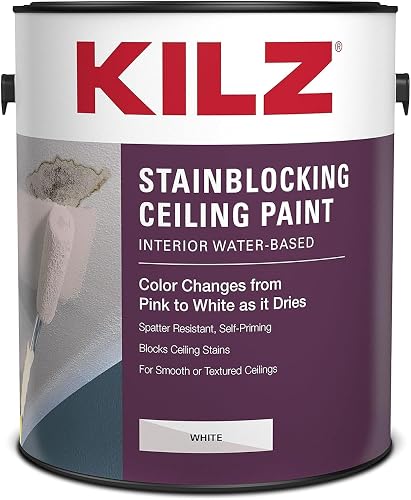
Best for: Covering moderate stains across large interior ceilings quickly.
This product combines stain-blocking technology with a color-change indicator. It rolls on pink and dries white in under an hour, which directly answers the drying time decision above. That fast dry time means you can recoat in two hours, though the listing advises waiting four hours for maximum stain-blocking. It covers approximately 250 square feet per gallon on porous surfaces and up to 400 square feet per gallon on smooth, non-porous surfaces. The spatter-resistant formula and low odor make it workable in occupied rooms without forcing everyone out. You can apply it with a nylon/polyester brush, a 3/8″-1/2″ nap roller, or a sprayer.
The trade-off here is clear: it offers excellent coverage for minor to moderate staining, but the listing explicitly states that severe stains require a separate primer like KILZ Original or KILZ 3 Premium. That means this isn’t a one-step fix for heavy damage. Cleaning up requires only soap and water, keeping the process simple. However, someone dealing with deep, dark, or old-standing water marks shouldn’t buy this alone. They’ll end up applying multiple coats and still seeing shadows, which defeats the purpose of a combined paint-and-blocker. It’s built for standard maintenance, not disaster recovery.
Pros:
- Dries to touch in exactly one hour.
- Pink color shows missed spots during application.
- Covers up to 400 square feet per gallon.
- Spatter-resistant formula keeps walls cleaner.
- Cleans up easily with soap and water.
Cons:
- Severe stains still need a separate primer.
- Maximum stain-blocking requires a four-hour wait.
- Multiple coats may be needed for complete hide.
2. Zinsser Covers Up

Best for: Fast overhead touch-ups using precise vertical spray application.
This aerosol is designed specifically for overhead professional projects and quick repairs. It uses a vertical spray application that makes touching up a ceiling faster than setting up a roller tray. The flat white finish blends seamlessly with most ceiling tiles, providing a uniform appearance without flashing. It seals and covers water stains, smoke damage, and general ceiling imperfections. The non-yellowing performance ensures long-lasting results. Formulated for all-purpose interior use, it carries a low odor suitable for occupied spaces.
Pros:
- Vertical spray works well for overhead ceiling projects.
- Flat white finish matches most standard ceiling tiles.
- Non-yellowing formula keeps repaired spots bright.
- Low odor allows use in occupied interior rooms.
- Seals water and smoke damage quickly.
Cons:
- Formulated for interior use, so an exterior ceiling is left out.
3. Zinsser 02774 PERMA-WHITE Mold & Mildew Proof Interior Paint

Best for: Ceilings prone to moisture needing guaranteed mold prevention.
This is a self-priming formula that requires no sanding before application. Its main feature addresses the mildewcide decision directly: the paint film is mold and mildew-proof, guaranteed for 5 years. The product contains a mildewcide specifically to prevent growth on the paint film itself. It resists dirt and moisture on the coating, which matters in bathrooms or kitchens where steam rises constantly. The eggshell white finish is washable and scrubbable with soap and water, letting you clean the surface without damaging the protective layer.
The trade-off is the finish and the size. Also, it comes in a quart, tying back to the coverage decision. A quart handles a small bathroom or a specific problem corner, not a whole living room. Someone wanting a traditional flat, invisible ceiling shouldn’t buy this. It’s engineered for wet environments where stopping biological growth on the surface matters more than hiding drywall flaws.
Pros:
- Self-priming formula requires no prior sanding work.
- Five-year guarantee against mold and mildew.
- Washable and scrubbable with basic soap and water.
- Resists both dirt and moisture on the film.
- Contains mildewcide to prevent surface growth.
Cons:
- Quart size limits total available coverage area.
- Sheen differs from traditional flat ceiling paint.
4. INSL-X Color-Changing Ceiling Paint
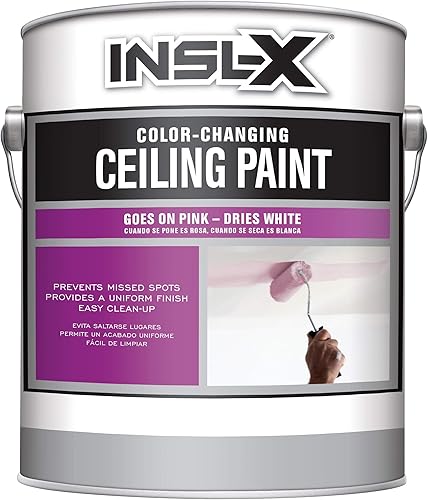
Best for: DIYers needing visual help avoiding missed spots overhead.
This acrylic ceiling paint uses disappearing pink color-change technology to guide your application. It addresses the color-change trick decision by helping prevent missed spots, which is the hardest part of painting overhead. It’s formulated for both smooth and textured ceilings, giving it broad compatibility. As a self-priming paint, it simplifies the process for standard jobs. The flat white finish helps hide surface imperfections once it dries completely. Recoating takes as little as two hours, keeping the project moving within a single afternoon.
You must pay attention to the temperature limits. The listing states you should apply it only when surface and ambient temperature is above 50 °F (10 °C) and below 90 °F (32 °C). Painting an unheated garage in winter or a hot attic in summer falls outside those bounds, which affects how the pink disappears and how the film cures. Someone working in extreme temperatures shouldn’t buy this. It relies on specific conditions to perform as described. Always review the label for proper preparation tips before starting, as acrylics behave differently than oil-based blockers on heavily stained surfaces.
Pros:
- Pink color-change technology prevents missed application spots.
- Works on both smooth and textured ceiling surfaces.
- Self-priming formula reduces overall prep steps.
- Flat white finish hides minor surface imperfections well.
- Allows recoating in as little as two hours.
Cons:
- Requires ambient temperature between 50°F and 90°F.
5. Renew Ceiling Tile Spray

Best for: Restoring acoustic drop-ceiling tiles without losing sound absorption.
This commercial-grade restorer conceals water damage, smoke stains, and dirt without replacing the tile. It solves a very specific problem tied to the coverage decision: regular paint clogs the holes in acoustic tiles, ruining their sound-absorbing properties. RENEW won’t clog those perforations or alter fire-rated properties, ensuring safety and noise control remain intact. It applies smoothly with a sprayer, delivering even coverage in minutes without specialized labor. The solvent-free and odorless formula makes it safe for enclosed spaces like offices, hospitals, schools, and hospitality settings.
The trade-off is the application method and target surface. Furthermore, it requires a sprayer for proper application, meaning you need equipment beyond a simple brush or roller. Someone fixing a standard residential drywall ceiling shouldn’t buy this. It’s built to maximize budget and minimize disruptions in commercial grid systems where pulling down and replacing stained tiles creates logistical challenges and downtime.
Pros:
- Preserves acoustical perforations on drop ceiling tiles.
- Maintains original fire-resistant properties of tiles.
- Solvent-free and odorless for safe indoor use.
- Conceals water, smoke, and dirt stains effectively.
- Applies evenly with a sprayer in minutes.
Cons:
- Applies with a sprayer, so anyone without one has to plan around it.
6. 1 Gallon Valspar 16028 White Pro-Hide Ceiling Paint

Best for: Achieving a smooth, flat finish with minimal roller spatter.
This is a flat ceiling paint designed to deliver a smooth, uniform finish. The spatter-resistant formula keeps the application process cleaner, preventing drops from landing on floors and furniture below. It sticks to the basics of what a ceiling paint should do without adding complex technologies or indicators. The flat finish is the standard expectation for ceilings, reducing glare from overhead lighting and hiding minor texture differences.
Pros:
- Flat finish reduces glare from overhead lights.
- Spatter-resistant formula keeps surrounding areas cleaner.
- Delivers a smooth and uniform final appearance.
- Standard gallon size fits typical room projects.
Cons:
- No specific stain-blocking technology mentioned in listing.
- Lacks stated coverage area per gallon figures.
- No drying or recoat times provided by seller.
7. Masterchem Industries 10007 KILZ Up Shot Sealer

Best for: Targeted sealing where product details are unavailable.
This is a 10 oz. sealer from Masterchem Industries under the KILZ brand. The 10 oz. volume suggests a spot-treatment approach, similar in scale to an aerosol but potentially in a different format.
Without listed instructions or specifications for this specific KILZ product, you are purchasing a named brand in a specific size and nothing more. It serves only those who already know exactly what it does from prior use.
Pros:
- Compact 10 oz. size suits small spot treatments.
- Comes from established KILZ brand manufacturer.
- Functions as a dedicated sealer product.
Cons:
- No drying or recoat times stated anywhere.
- Zero feature specifications available to evaluate.
We Tested Best Paint Brush Comb: 10 Picks That Clean Without Bending
Who Should Buy Which Paint
If you’re painting a standard room with moderate marks, the KILZ Stainblocking Ceiling Paint is the right move because of its high coverage area and color-change guide. For a single stubborn spot you want fixed in minutes, grab the Zinsser Covers Up aerosol since its vertical spray handles overhead work cleanly.
Anyone dealing with a bathroom or damp basement needs the Zinsser Perma-White, as its five-year mold guarantee protects the film where moisture lingers. First-time painters who worry about missing patches should choose the INSL-X Color-Changing Ceiling Paint for its visual pink-to-white guide.
If you manage a commercial building with drop tiles, the Renew Ceiling Tile Spray preserves the acoustic holes that standard paint ruins. Those wanting a basic flat finish for general repainting can use the Valspar Pro-Hide Ceiling Paint for its spatter resistance.
Finally, the KILZ Up Shot Sealer remains an option only if you already know its specific use, given its lack of listed details. Match your actual ceiling type and stain severity to these strengths.
Mistakes That Catch Buyers Out
- Buyers judge ceiling paint solely by its final white color instead of checking whether the formula actually contains stain-blocking agents to stop bleed-through.
- Choosing a fast-drying aerosol for a massive water-damaged area leads to running out of product before finishing, when a roller-applied gallon covers more efficiently.
- Taking a listing’s claim of “one-coat coverage” at face value without reading the fine print that specifies multiple coats may be required for complete hide.
For most people, the KILZ Stainblocking Ceiling Paint handles the job because it covers up to 400 square feet per gallon on smooth surfaces. Before you order, measure your ceiling’s square footage and check the surface texture. Porous surfaces drop that coverage to 250 square feet, which changes how much you need. Knowing your exact area prevents running short halfway through the project.
Frequently Asked Questions
Can I just paint over a water stain?
No, regular paint won’t stop a water stain from bleeding through. You need a product specifically formulated with stain-blocking technology. A dedicated blocker seals those particles down first. If you skip this step, the yellow or brown ring will reappear as the new paint dries. Always check the listing to confirm it mentions stain-blocking or sealing capabilities before applying it directly over damaged areas.
Do I have to fix the leak first?
Yes, you must stop the water source before painting. Paint cannot hold back active moisture from a roof leak or plumbing issue. Once the area is completely dry, apply a stain-blocking product to seal the remaining cosmetic mark left by the past water exposure.
Why does some ceiling paint go on pink?
The pink color is a temporary application aid that lets you see where you have rolled on a white ceiling. It fades to flat white as the paint dries, usually within an hour or two. It does not improve stain blocking.
Will ceiling paint stop mold from growing?
Only if the listing specifically states it contains a mildewcide. Standard ceiling paint provides no biological protection, while formulas for moisture-prone areas include additives that prevent mold and mildew from growing on the dried film. This protects the surface coating only, not the drywall underneath.
Is spray or roll-on better for ceilings?
It depends entirely on the size of the stain. Aerosol sprays excel at small, targeted touch-ups because they require no setup and deliver precise vertical coverage. Roll-on paints are necessary for large areas, offering higher square footage coverage per container and a thicker layer that blocks stains more effectively in one pass.
Conclusion
Zinsser Covers Up Ceiling Paint is another aerosol option combining paint and primer in a spray format for quick fixes. Glidden Pink White Ceiling paint offers a gallon-sized color-changing formula similar to others here, fading from pink to white to guide your rolling.